How Much Should Cleaning Businesses Spend on Google Ads in Australia?
There is no universal “right” Google Ads spend for cleaners. The useful number is whether a booked job still makes money after clicks, quoting time and the work itself.
Growth Professionals · 25 Oct 2026 · Australia · About a 11-minute read. No invented client results. Figures are worked examples, not promises.
Spend is a job-economics question
“How much should I spend on Google Ads?” is the wrong first question for a cleaning business. The useful question is: for the jobs you actually want, what can you pay to win a booked clean and still make money after product, quoting time and the work itself?
That is why this article does not publish a national cost-per-click chart. Clicks move by city, by job type and by how crowded the auction is this month. A copied benchmark becomes a fake statistic the moment it is treated as your number. The educational pillar is Google Ads for cleaning businesses. Cost mechanics sit on Google Ads cost for cleaning businesses. The commercial page is /services/google-ads. This article is the decision: whether a given spend makes sense for your diary.
Growth Professionals does not switch ads on in week one. The starting plan is $399 setup and $200 a week for the website, Google presence, tracking and first search work. If ads are added later, campaign setup is $189 once-off and management is $59 a week. Media spend is yours, paid to Google or Meta. We do not guarantee leads, cost per lead or revenue.
Separate three different costs
Operators mix these up and then think “ads do not work”:
- Media spend — what Google or Meta charges for clicks or impressions.
- Management — $59 a week if Growth Professionals runs the campaigns later.
- The job — wages, travel, products, and the time to quote jobs you do not win.
A $150 media week that produces one $180 weekly clean can be a good week. The same $150 that produces four Saturday bond cleans you cannot staff is a bad week — even if the dashboard says you got “leads”.
A simple way to size a starting budget
Use this on paper before you open Google Ads:
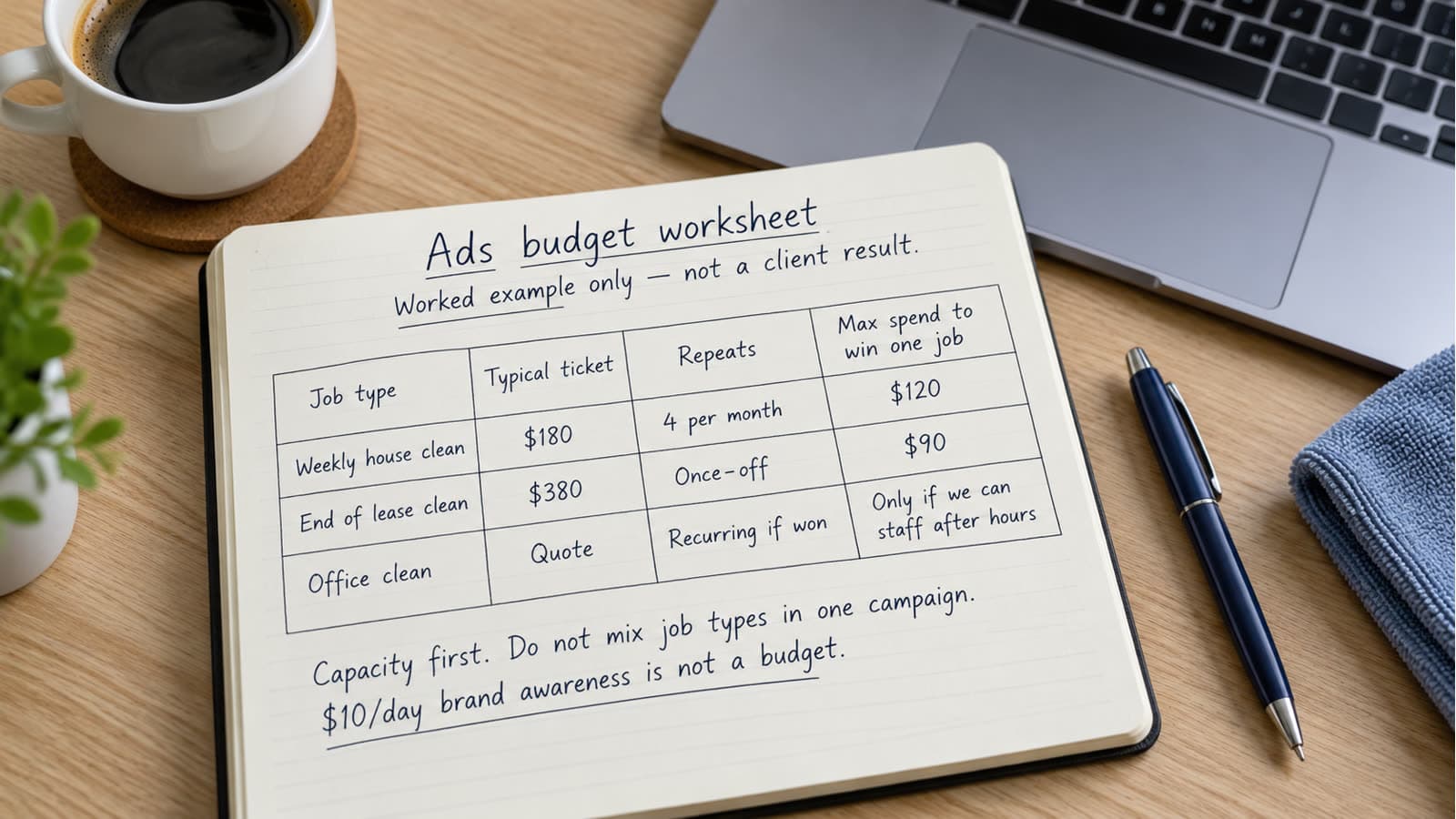
- Pick one job type you want more of. Not three.
- Write the typical ticket and how often that customer repeats.
- Write how many extra jobs you can actually take next month.
- Decide the most you can pay to win one of those jobs and still sleep.
- Only then work backwards to a weekly media number. If you cannot answer the phone, stop here.
If you want consistent enquiries without relying entirely on advertising, start with a structured SEO strategy for cleaning companies and the client-getting guide — then add ads only when the diary can use them. That is the same order as the cleaning business marketing hub.
Worked example: weekly house cleaning
Worked example only. Your prices will differ. A $180 weekly clean, four times a month, is $720 a month. If that customer stays six months, that is $4,320 before extras. Paying $120 in clicks to win that customer can be rational. Paying $120 to win a once-off $180 tidy-up is not the same maths.
Suppose you spend $200 in a week on Search, get a handful of clicks, three quote requests and one booked weekly clean. The click cost is not the story. The story is whether that customer’s recurring work covers the $200, the $59 management week if we are running the account, and the time to quote the two that did not book.
If you are a one-person operator already full on Tuesdays and Thursdays, buying more weekly-home clicks just fills a waitlist. Pause the campaign or narrow the suburbs. Capacity is part of budget.
Worked example: end of lease
End of lease and bond cleans are urgent and price-sensitive. They fill gaps. They also wreck a week if every Saturday is already booked. Worked example only: a $380 bond clean that you can do on a weekday might support a higher click cost than a $180 weekly that you cannot fit.
The failure mode is mixing end of lease with weekly homes in one campaign. Google will spend on whichever query is cheaper or more frequent. You will think “Google Ads is expensive” when you are really buying the wrong job.
Worked example: commercial
A commercial quote can look expensive per click and cheap per year if it becomes a recurring site. It can also burn a month of quoting for a tender you will not win. Do not start a commercial campaign because the ticket is large. Start one because you can actually service offices after hours, you have insurance in order, and someone can walk the site.
If you only want residential work, put commercial terms in negatives. Budget is also what you refuse to buy.
Campaign structure before the dollar figure
A starting Search setup for a cleaner is usually one campaign per job type you can take: weekly homes, end of lease, offices. Keep the geography honest. Write ads that name the job and the area. Send each ad to the matching page — not the homepage. If that page cannot convert, read cleaning service landing pages and why cleaning websites fail to generate leads before you raise the budget.
Brand-awareness Display at $10 a day is the other common mistake. Search Console for this business already shows thousands of generic agency impressions and almost no clicks. Buying more generic impressions will not create a branded search query. It will not teach Google that this company is for cleaning operators.
When ads are worth paying for is already written on the ads question page. The short version: tracking, a quote path, someone answering, room in the diary, and a media budget separate from the $200 week.
What a profitable week looks like on paper
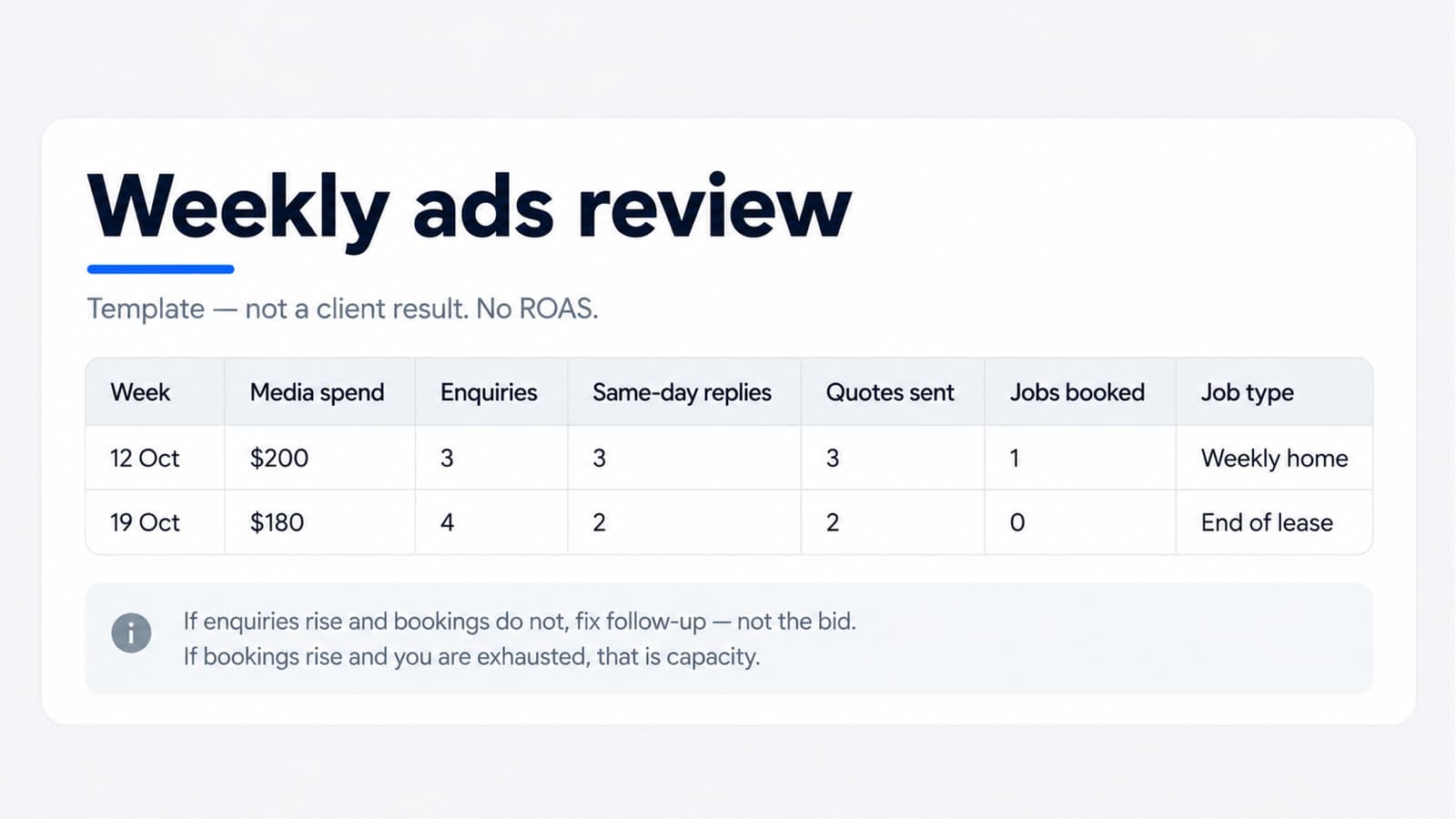
Keep a weekly row, not a dashboard screenshot: media spend, enquiries, replies same day, quotes sent, jobs booked, job type, source. If enquiries rise and bookings do not, the problem is follow-up or the offer — not the bid.
If bookings rise and you are exhausted, the problem is capacity. Growing the diary is a different article: how to grow a cleaning business from $5K to $20K a month. Do not buy more clicks into a bottleneck.
How this fits the rest of the cluster
This page supports the Google Ads hub. It does not replace /services/google-ads. A later sub-pillar can go deeper on landing pages; until then, the conversion gaps live in the website guide. Local visibility without paying for every click lives in the local SEO checklist.
If you only remember one number, remember this: media spend is not a marketing personality. It is the price of a booked job you can actually do.
Questions operators ask
Is $10 a day enough for Google Ads as a cleaner?+
Usually not as a brand-awareness campaign, and often not as Search either. Competitive clicks can use that budget in a handful of visits. A small Search budget can work if it is limited to one job type and a few suburbs you can actually serve — not “get the name out”.
Does Growth Professionals’ $200 week include ad spend?+
No. The starting plan is $399 setup and $200 a week for the website, Google presence, tracking and first search work. If ads are added later, campaign setup is $189 and management is $59 a week. Media spend is yours, paid to Google or Meta.
Should residential and end of lease sit in the same campaign?+
No. They are different urgency, different proof and different diary pressure. Mixing them hides whether you are paying for the jobs you want.
When should a cleaning business turn ads on?+
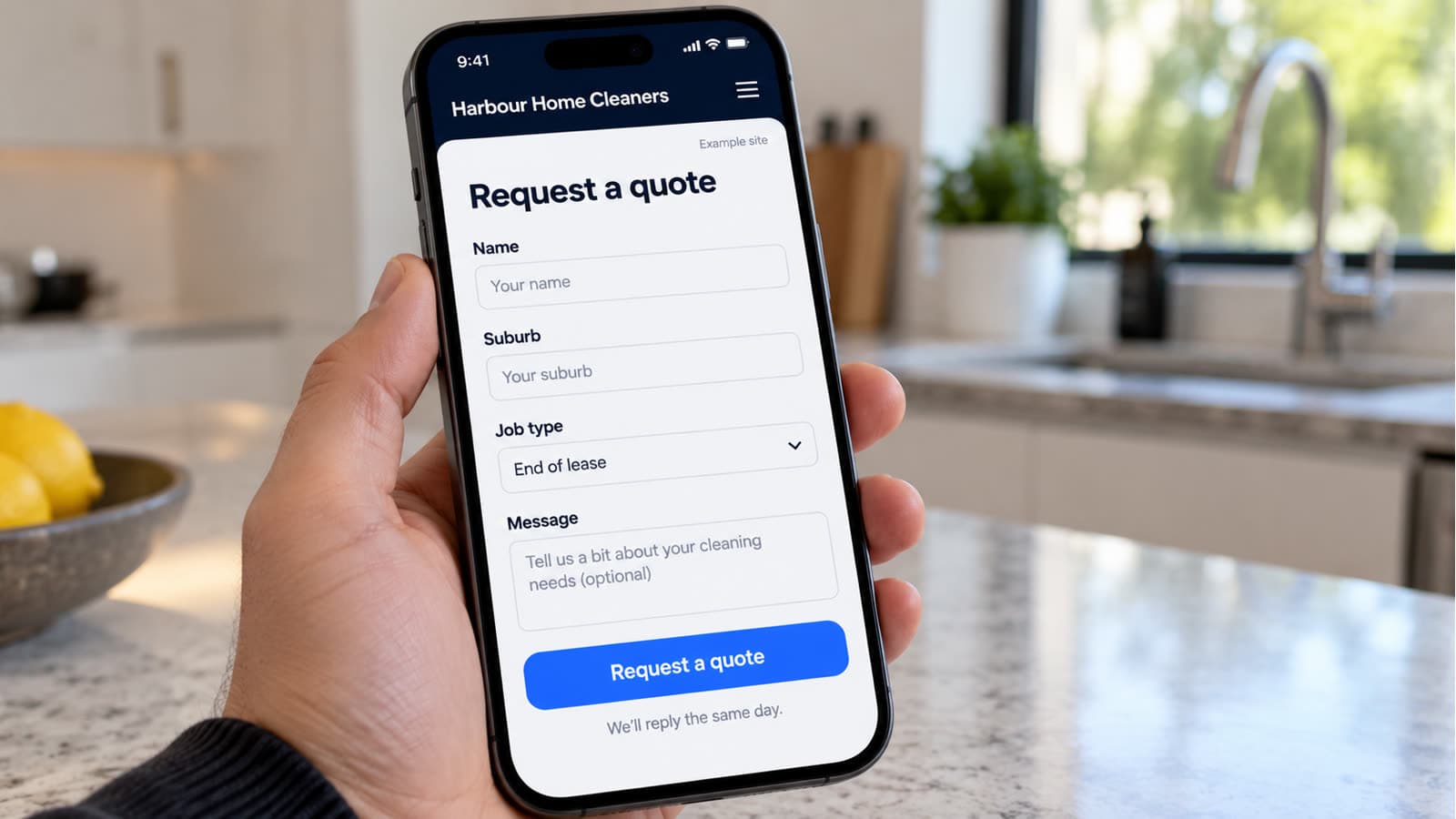
When the website can take a quote, tracking is in place, someone can reply the same day, and you have room in the diary. Ads before that buy missed quotes.
Keep going
Sibling guides in this cluster. Each one links back to the marketing hub and to /book.
 Websites
10 minutes read
10 Reasons Your Cleaning Business Website Isn't Generating Leads
Poor page speed, unclear services, missing service areas, weak calls to action, form friction and sending ads to a homepage that cannot convert.
Growth Professionals
Last updated on 25 Oct 2026
 Cleaning Business Marketing
12 minutes read
How to Get Cleaning Clients in Australia: 15 Strategies
Google Business Profile, service pages, local SEO, ads only when you are ready, referrals, retention and how to measure a booked job — not vanity traffic.
Growth Professionals
Last updated on 25 Oct 2026
 Growth
11 minutes read
How to Grow a Cleaning Business from $5K to $20K per Month
Worked revenue scenarios, recurring vs once-off, pricing, staff capacity, retention and the marketing order that supports the diary you can run.
Growth Professionals
Last updated on 25 Oct 2026