Blog · Cleaning Business Marketing
How to Get Cleaning Clients in Australia: 15 Strategies
Consistent cleaning work rarely comes from one Facebook post or a generic “marketing agency” ranking. It comes from being findable for the jobs you actually want, looking like a real business when someone checks you, and following up before the next cleaner does.
Growth Professionals · 25 Oct 2026 · Australia · About a 12-minute read. No invented client results. Figures are worked examples, not promises.
Why getting consistent cleaning clients is difficult
Cleaning demand is real. The problem is the mix. A weekly house clean, a same-day end of lease, and a commercial contract are different businesses hiding under one industry label. If your website, Google profile and ads treat them as the same enquiry, you will fill the diary with the wrong jobs — or with quotes that never book.
In Australia that mix shows up in the search box. “House cleaner near me”, “end of lease cleaning [suburb]”, “office cleaner after hours” and “commercial cleaning quote” are not one campaign with four synonyms. They are different urgency, different proof (insurance vs before/after photos) and different follow-up. A page that tries to rank for all of them usually ranks for none of them well.
Most operators also start marketing too late in the chain. They buy ads before the site can take a quote. They post on Instagram with no Google Business Profile. They wait for referrals while the profile still has the wrong category. The list below is the order we actually use: presence and tracking first, paid traffic later.
This guide is the practical list. It sits under the cleaning business marketing hub. If you want consistent enquiries without relying entirely on advertising, start with a structured SEO strategy for cleaning companies and an optimised Google Business Profile — then add ads only when the diary can use them.
1. Optimise your Google Business Profile
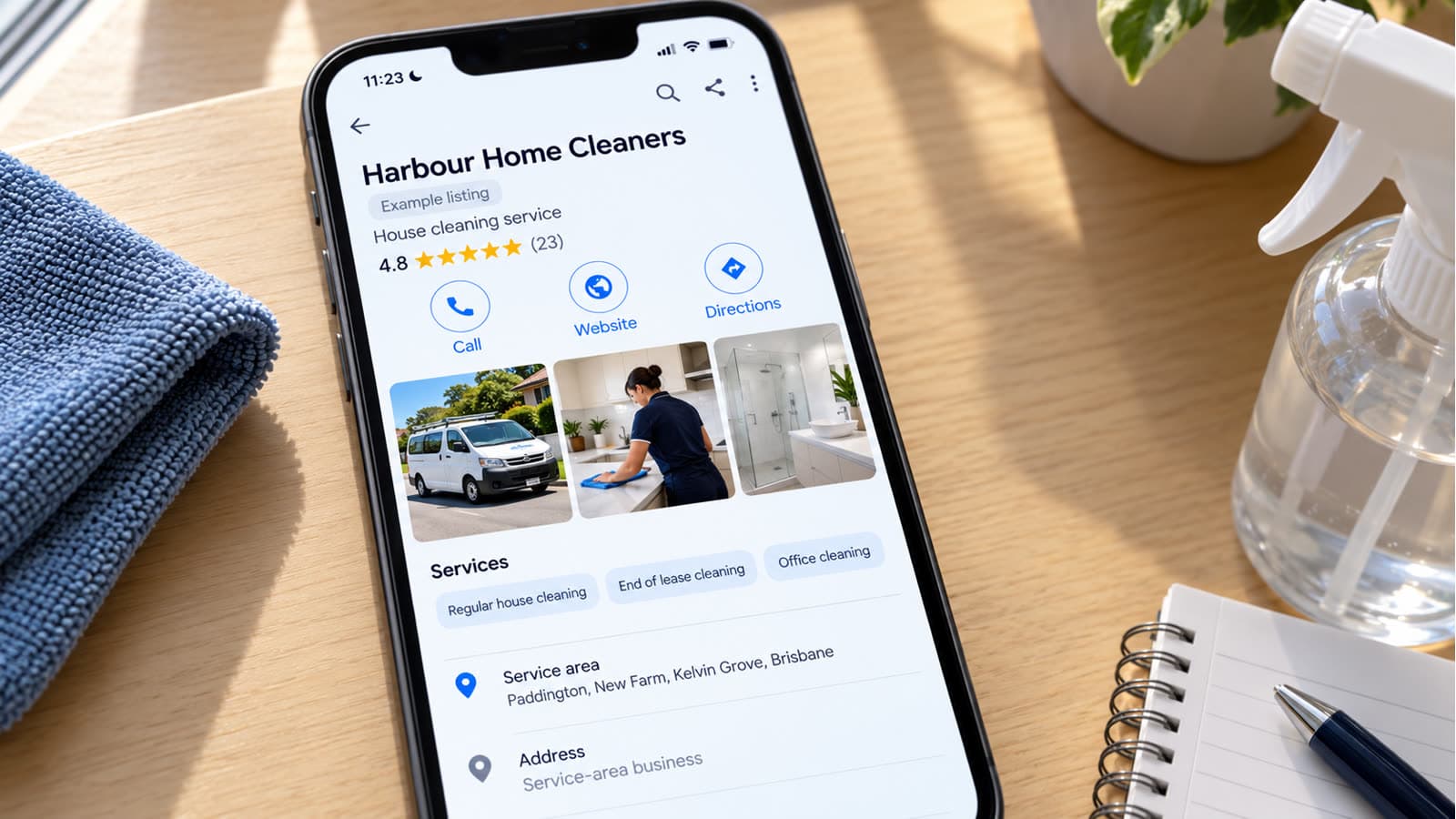
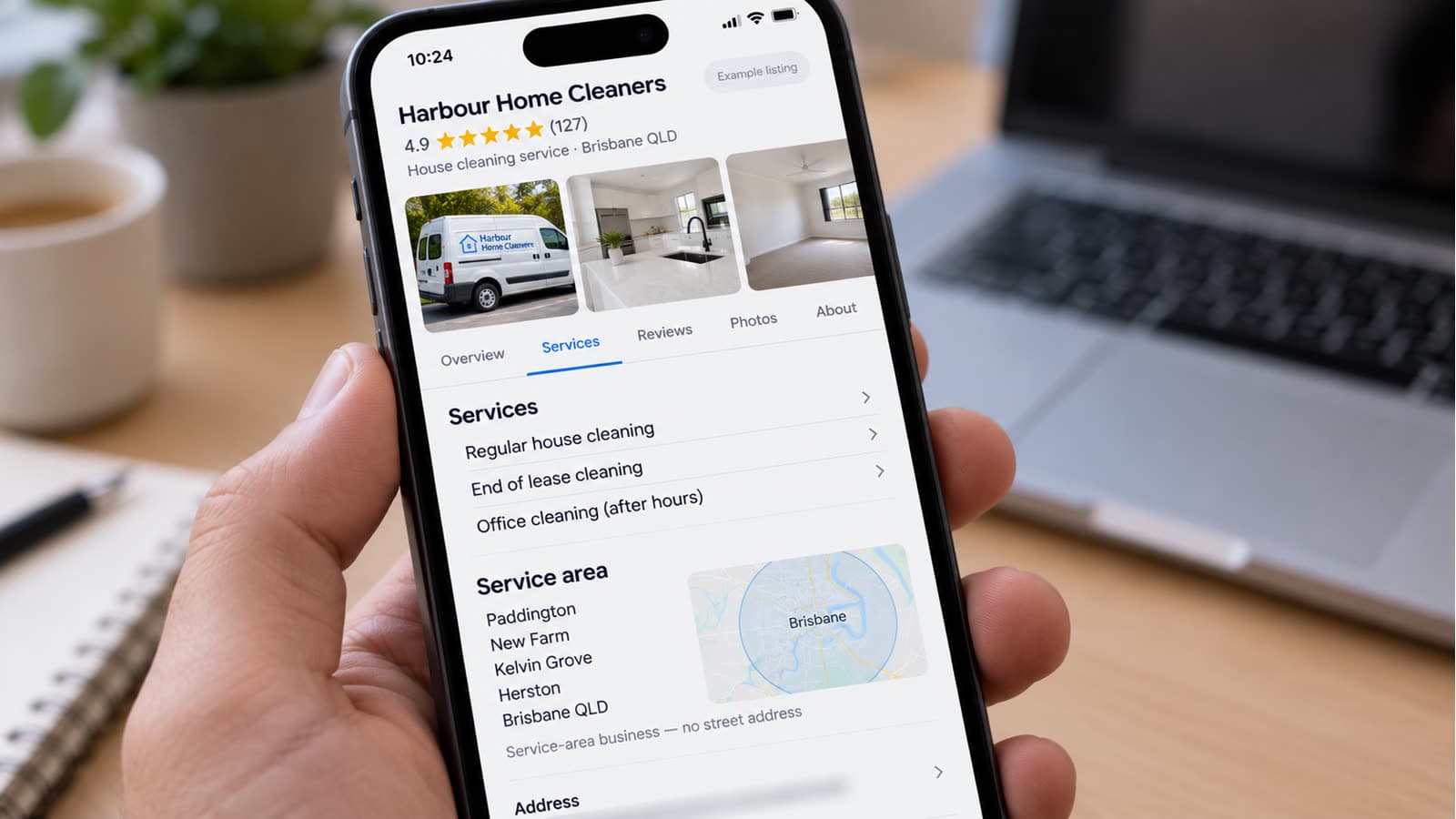
A lot of cleaning jobs still start on Google. The map pack is often more important than a blog ranking. Use the category that matches the work (for example, House cleaning service), list the services you actually sell, set the suburbs you can reach, and put the same website and contact path as the site.
If you cover a service area rather than a shopfront, say so clearly and keep the area honest. Listing half the state and then declining jobs 40 minutes away trains Google and customers the wrong way. Name the suburbs you can reach on a normal Tuesday, not the ones you might take if the price is high.
Photos of real vans, uniforms, equipment and finished rooms beat stock. Reviews need a simple ask after a completed job — not a software trick. A profile on its own will not put you first on the map. It has to match the rest of the marketing system.
The full Google Business Profile guide is /google-business-profile-cleaners— one page, not a second competing blog. This section stays the short version inside the 15 strategies.
2. Build a professional cleaning business website
People check you between jobs. If the site is slow, vague, or built on a personal Gmail, they call the next cleaner. The site has one job: say what you clean, where you work, and how to ask for a quote on a phone.
That is month 1 in the Growth Professionals plan — not a custom app, and not ads. See websites built to convert for what the work includes, and ten reasons cleaning websites fail to generate leads if the phone is still quiet: service pages, mobile speed, quote forms, and a structure Google can read.
A workable first site is small: home, the services you sell, about, contact, and a quote form that works with a thumb. Put the suburbs on those pages. Put the same business name on the site and on Google. Do not hide the next step in a hamburger menu on a phone — the quote path has to be obvious on every important page.
3. Create individual service pages
“We clean everything” is easy to write and hard to rank. Weekly homes, end of lease, offices and commercial quotes use different words, different urgency and different proof.
Start with the jobs you want more of. One page per main service, with the suburbs you cover, what is included, and a quote form. Add city or suburb pages only where you genuinely work — Brisbane is the city we index first on this site for a reason. Identical city pages that read like a generic agency teach Google the wrong story.
4. Improve local SEO
Local SEO is the combination of the profile, the service pages, reviews, and internal links that tell Google you are a cleaning company in a real area. It starts with the website and keeps going. It is not a one-week job.
Useful signals are boring on purpose: NAP consistency (name, public contact path, website), suburb relevance, service-page titles that match how people search, and internal links from the homepage to those pages. Identical location pages with the city name swapped are not local SEO. They are how a site ends up ranking for the wrong city.
Watch Search Console for the queries you actually want: house cleaner, end of lease cleaner, office cleaning — not “digital marketing agency near me”. If you want the organic path without paying for every click, that is the SEO work. Use the local SEO checklist for cleaning businesses as the field list; it is not a second Google Business Profile article.
5. Use Google Ads to attract ready-to-book customers
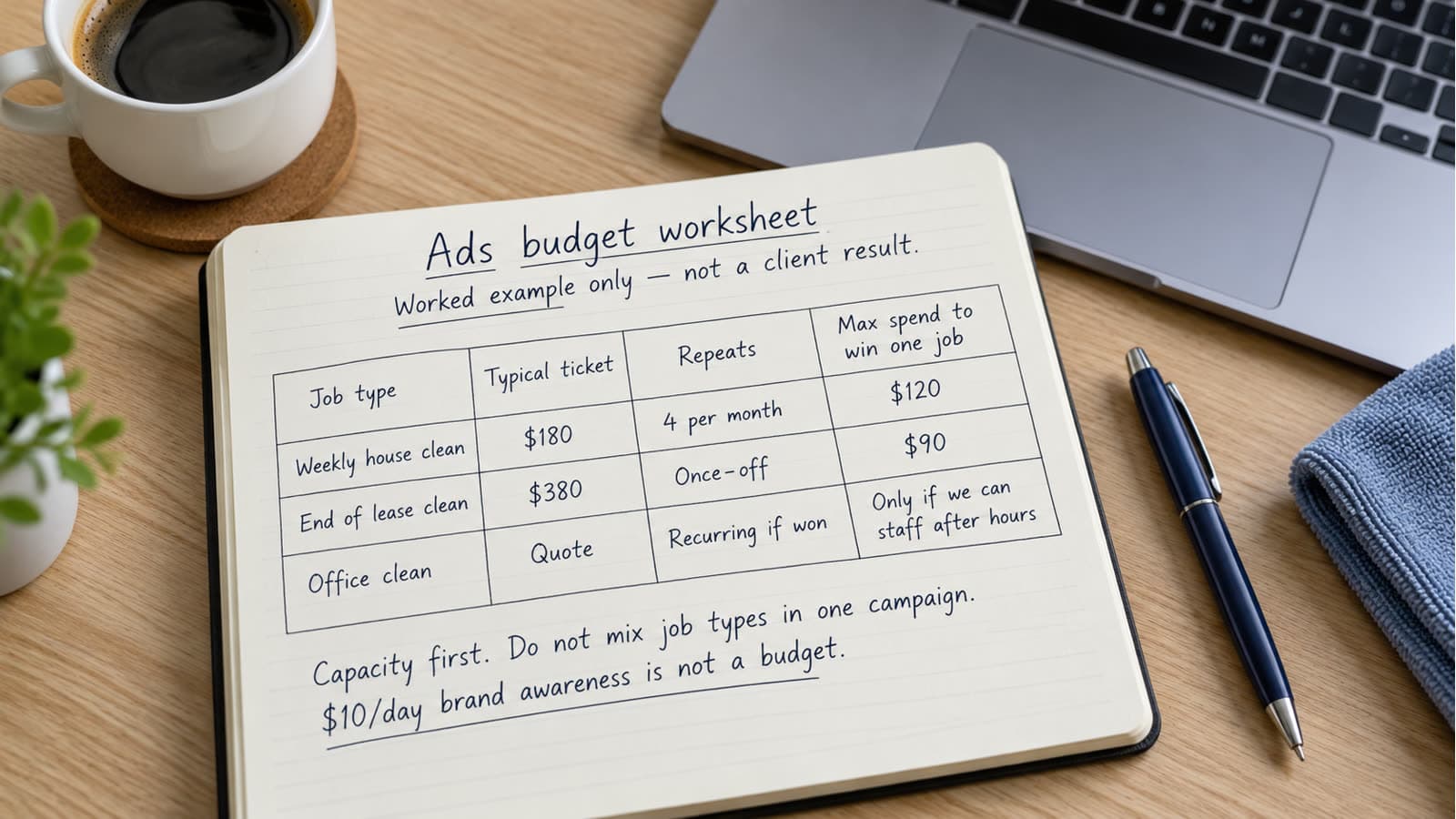
Ads are useful when someone is already looking for the job you do. They are a poor way to “get the name out” at $10 a day. Competitive agency clicks in Australia often cost more than that each; cleaning job clicks vary by city and service. The number that matters is cost per booked job, not cost per click.
Worked example only: if you spend $150 in a week on Search, get eight clicks, three quotes and one booked weekly clean, that click cost is not the story. The story is whether that customer’s recurring work covers the $150 plus the $59 management week and the time to quote. If the same $150 produces four end-of-lease enquiries you cannot fit on Saturday, the campaign is the wrong job type — not “Google Ads does not work”.
Do not switch ads on until tracking works, someone can answer the phone, and you have room in the diary. Growth Professionals charges $189 once-off for campaign setup and $59 a week for management. Media spend is yours, paid to Google or Meta. We do not guarantee leads, cost per lead or revenue. The current Google Ads page, the guide on how much cleaners should spend on Google Ads, and when ads are worth paying for spell out the order.
6. Collect genuine customer reviews
Reviews are how a new cleaner looks less new. Ask after a completed job, while you are still on site or in the follow-up message. Send people to Google first. Do not write the review for them. Do not buy them.
A simple process beats a complicated one: one link, one ask, one reminder. Volume over time is the signal Google Business insights actually uses.
7. Develop a customer referral programme
Recurring customers already trust you. A credit on their next clean for a referred weekly client is usually cheaper than a paid click, and the job quality is often better. Keep the offer small and written down so it does not turn into awkward discounts.
Tell people on the invoice, in the reminder text, and once on the website. If nobody can explain the offer in one sentence, it is not a programme yet.
8. Build relationships with real estate agencies
End of lease and vacant-property work often sits with property managers. That is a relationship, not a Google ad: reliable turnaround, clear inclusions, and photos they can send to an owner.
Do not promise every agency in the suburb. Pick a few offices you can actually serve well. Price-sensitive, urgent jobs still need a page on the site so those searches and referrals land somewhere coherent.
9. Promote recurring cleaning services
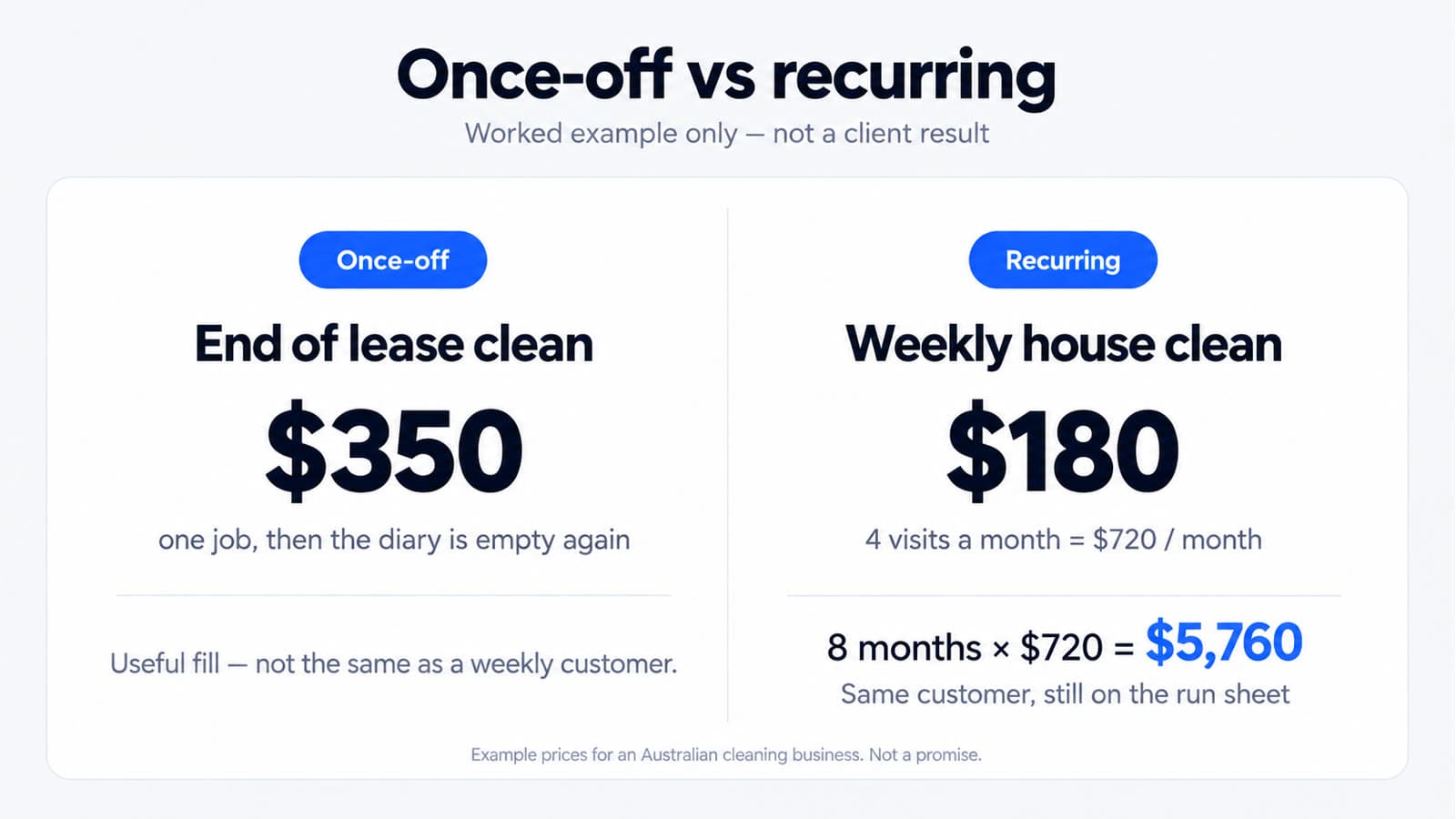
A once-off end of lease and a weekly house clean are not the same value. Worked example only: a $180 weekly clean, four times a month, is $720 a month. If that customer stays eight months, that is $5,760 before you count extras. A $350 bond clean can fill a quiet week. It is not the same as a weekly customer who stays.
Say the recurring offer on the homepage and the house-cleaning page. Make it easy to go from a first clean to a regular slot. Marketing that only chases once-off jobs will keep you quoting forever.
10. Use Facebook and Instagram strategically
Social is proof, not a lead machine. Before-and-after photos, the van, the team, the suburbs you cover, and the same offer as the website. A posting rhythm beats a burst of content then silence.
People check you after they find you. An empty page makes them hesitate. It is rarely how the phone rings. See social media for cleaning companies for what we actually set up — brand consistency, not a viral promise.
11. Follow up on enquiries quickly
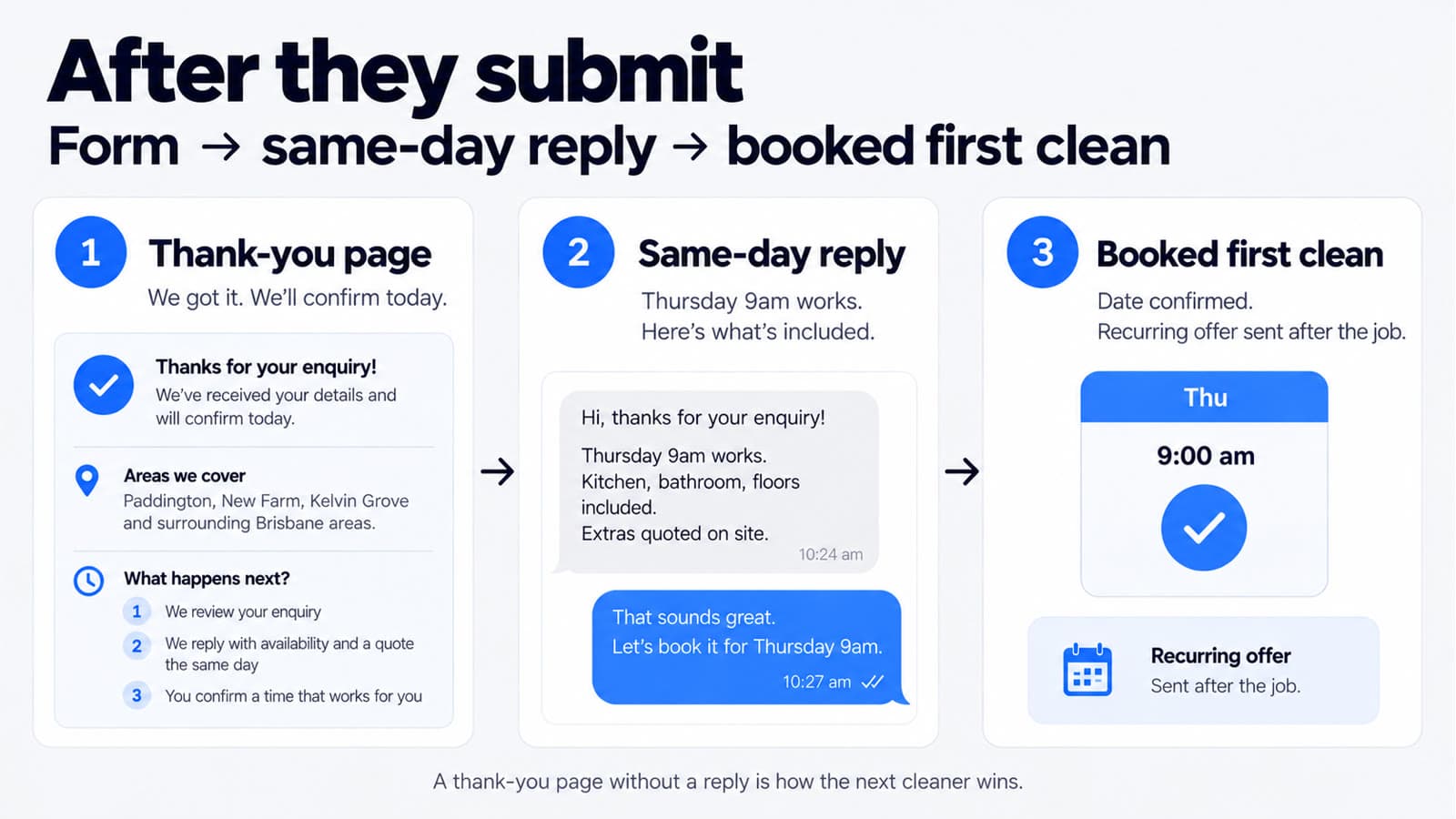
Cleaning quotes go cold in hours, not weeks. A short same-day reply — even “we can do Thursday morning, here is what is included” — beats a polished proposal tomorrow. If you cannot answer the phone during jobs, use a form that emails you and a template you can send from the van.
Write the template once: suburbs you cover, earliest slot, what is included, what is extra, and how to confirm. Property managers want inclusions and photos. Householders want date and price. Commercial enquiries often want insurance and after-hours capability. One generic “thanks for your enquiry” email is how good leads go to the operator who answered first.
Follow-up is also why ads fail early. If nobody is free to reply, paid clicks become missed quotes. Capacity comes before spend.
12. Introduce online booking and reminders later
You do not need an app in month 1. Booking, reminders and a proper system come when the same jobs happen every week. An app is not in the $200 week. Treat online booking as a later layer, not the foundation. The app question is written that way on purpose.
What you do need early: a quote form that works on a phone, and a way to confirm time, address and inclusions in writing.
13. Build local partnerships
Carpet cleaners, pest control, handymen, interior stylists and builders send work when they trust you will not embarrass them. The same rule as real estate: a few good relationships, not a hundred flyers.
Make it easy for them: one contact, one service list, one area map. Reciprocate only where it does not confuse the offer. Partnerships support the Google and website work. They do not replace it.
14. Retain existing customers and encourage repeat bookings
Keeping a weekly clean is marketing. Reminder texts, a consistent cleaner where you can, and a simple way to skip or move a week will save more revenue than another click. Retention is also how you get reviews and referrals.
Do not bury the regular-clean offer. If the site only talks about “call for a quote”, people will treat you as once-off even when you want recurring work.
A short reminder before a scheduled clean, and a short “how did we go?” after it, is enough to keep the slot and to ask for the Google review. You do not need a loyalty app for that. You need a calendar and a message you actually send.
15. Measure leads, conversion and what a customer is worth
Connect the site so a form or a call shows whether it came from Google, a post or an ad. Then look at booked jobs, not vanity traffic. A page with 7,000 impressions and no clicks is not a channel — it is a mismatch. That is exactly the pattern we saw on generic city agency queries.
A simple weekly view is enough: enquiries, replies within a day, quotes sent, jobs booked, source. You do not need a full office system until the inbox cannot hold it. That step comes later.
$100K in year one is about $8,333 a month — a planning number, not a guarantee. Use it to decide which jobs you want more of, not as a headline promise. The $100K explanation stays on its own page so this guide does not over-claim. For the arithmetic on mix and capacity, use growing a cleaning business from $5K to $20K a month.
How this fits the Growth Professionals plan
The starting plan is $399 setup and $200 a week, three-month minimum. It is for cleaning businesses. It puts the website, Google profile, tracking and first search work in place. Ads, office systems and technology wait until the diary can use them. You keep the site, the profile and the accounts.
If you want the commercial map of residential vs commercial vs end of lease, use the cleaning companies industry page. If you want the system order, stay on the marketing hub. This article is the field list you can work through this month. The rest of the cleaning business guides sit under the same cluster so Google can crawl them as one topic.
Questions operators ask
How long does it take for SEO to bring cleaning clients?+
Local SEO is slower than ads. A complete Google Business Profile and a clear website can start helping within weeks; ranking for competitive suburb terms usually takes months of consistent pages, reviews and Search Console work. It is not a one-week job.
Should I start with Google Ads or Google Business Profile?+
Start with the website, Google Business Profile and tracking. Ads are useful when someone can answer the phone, you can take the work, and you have a separate advertising budget. Growth Professionals does not switch ads on in week one.
Is Facebook enough to get cleaning jobs?+
Social is useful for trust after someone finds you. Most cleaning jobs still start on Google — the map pack, a search, or a referral that then checks you online. An empty profile makes people hesitate; it is rarely how the phone rings on its own.
How many service pages does a cleaning website need?+
One page that says you clean everything rarely wins the search. Start with the jobs you actually want: weekly homes, end of lease, office or commercial. Add suburb or city pages only where you genuinely work.
What should a one-person cleaner spend on marketing?+
The Growth Professionals starting plan is $399 setup and $200 a week, with a three-month minimum. That covers the website, Google presence, tracking and first search work — not ads, a custom app or a full office system. Advertising spend, if you add it later, is extra and paid to Google or Meta.
Keep going
Sibling guides in this cluster. Each one links back to the marketing hub and to /book.
 SEO for Cleaning Companies
9 minutes read
Local SEO Checklist for Australian Cleaning Businesses
Service pages, honest service areas, reviews, name-and-website consistency, internal links and the Search Console queries that actually mean a booked job.
Growth Professionals
Last updated on 25 Oct 2026
 Google Ads
11 minutes read
How Much Should Cleaning Businesses Spend on Google Ads in Australia?
Separate media spend from management fees. Use worked examples for weekly, end of lease and commercial work. Do not switch ads on to “get the name out”.
Growth Professionals
Last updated on 25 Oct 2026
 Growth
11 minutes read
How to Grow a Cleaning Business from $5K to $20K per Month
Worked revenue scenarios, recurring vs once-off, pricing, staff capacity, retention and the marketing order that supports the diary you can run.
Growth Professionals
Last updated on 25 Oct 2026